





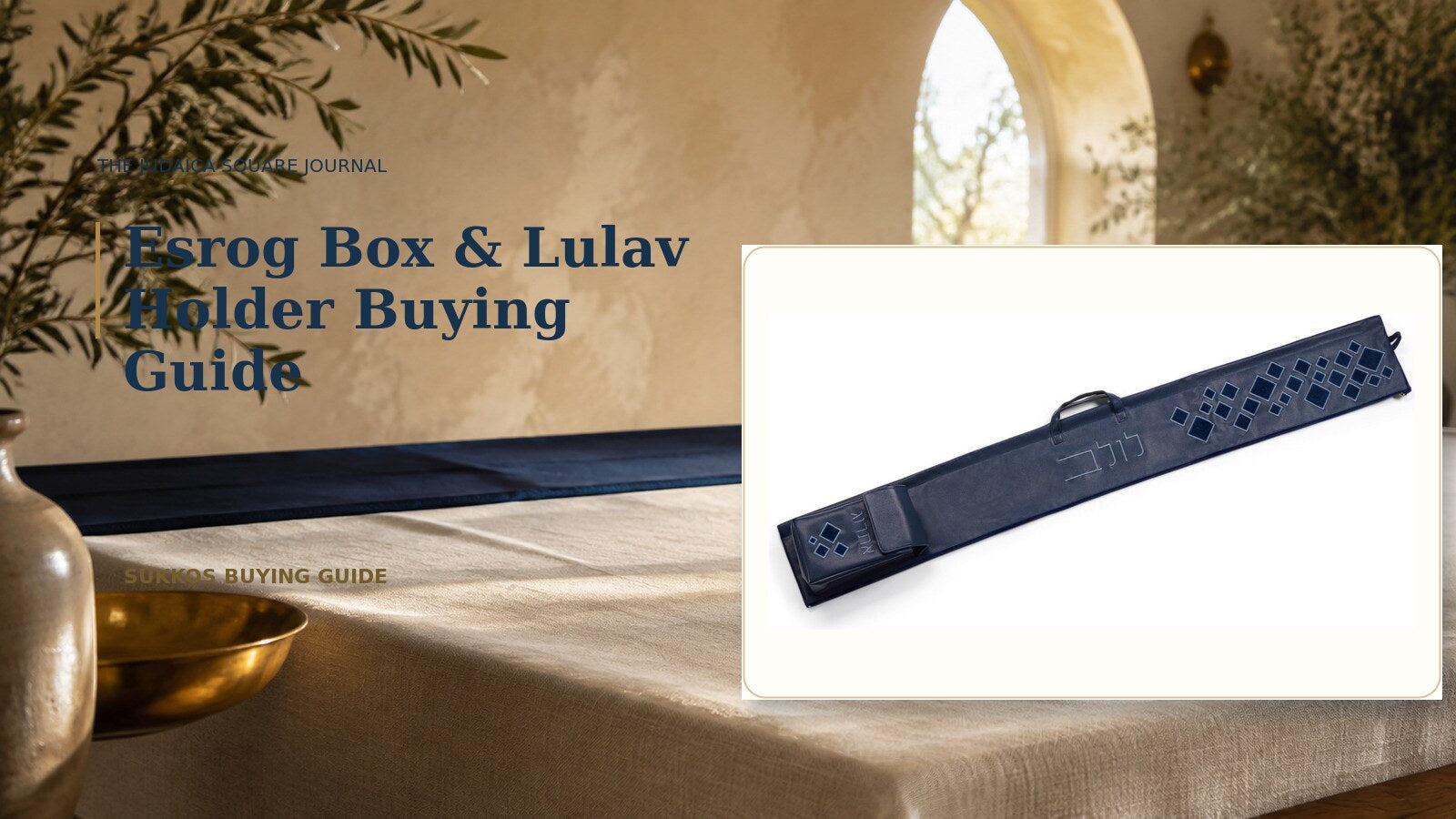
Esrog Box & Lulav Holder Buying Guide
The right esrog box or lulav holder is the one that protects the arba minim and fits the way you actually carry them. A beautiful case that is too short, too tight, awkward on a long walk to shul, or difficult to store will become frustrating very quickly.
Start with three questions: Do you need rigid protection or a lighter carrier? Will you usually walk, drive, or travel with the set? Are you buying only an esrog case, only a lulav holder, or a coordinated set?
This is a practical accessories guide, not a guide to choosing kosher arba minim. The esrog, lulav, hadassim, and aravos—and the standards your family follows—are halachic matters. Arrange them through a trusted source and bring specific questions to your rav. A carrier protects the minim; it does not establish their kashrus.
For the full category, browse lulav and esrog essentials. If you already know which piece you need, go directly to esrog boxes, cases, and bags or lulav bags, holders, and cases.
The quick answer: match the carrier to the trip
- Walking to shul: Look closely at the handle or shoulder strap, overall weight, closure, and how the case feels when carried upright.
- Mostly driving: Prioritize a firm structure and a shape that will sit securely in the car without rolling or being crowded by other items.
- Frequent travel: Choose protection first, then confirm the exterior dimensions against your luggage and transportation plans.
- Buying for a child or teen: Keep weight, easy closures, and the actual length of the set in mind. A grown-up style is nice; comfortable carrying is better.
- Giving a gift: A coordinated set or personalized carrier can feel special, but confirm size, spelling, color, and the recipient’s existing pieces before ordering.
There is no single material that is best for every person. The key is to separate protection, carrying comfort, appearance, and storage instead of expecting one feature to solve everything.
Esrog box, hard case, or soft bag?
These names are sometimes used loosely, so read the product page rather than relying only on the title. The most important distinction is what is actually protecting the esrog inside.
Rigid boxes and hard-sided cases
A rigid shell is designed to take the pressure of normal handling instead of allowing that pressure to reach the contents. This is the strongest starting point for someone who carries the esrog through a busy shul, packs it in a car, or wants a case that holds its shape in storage.
Check the interior dimensions, the type of padding or insert, how the lid closes, and whether the handle is attached to the rigid case or only to an outer cover. Never assume that a standard-looking box fits every esrog and every inner container.
Soft and padded esrog cases
A soft case or pouch is lighter and easier to fit into a cabinet after Yom Tov. It can also work as an attractive outer carrier around a separate protective box. The tradeoff is structure: padding can cushion ordinary bumps, but a soft wall does not behave like a rigid shell.
Some listings include an inner box, insert, or specific protective construction; others are simply bags. Confirm exactly what is included on the live product page before choosing.
Lucite and acrylic styles
Clear or decorative acrylic designs give the esrog box a modern, display-ready look. Compare the base, lid, handle, closure, and interior support—not only the exterior design. If the piece will be carried outside the home, make sure the carrying method suits the route to shul as well as the Sukkos table or shelf.
Wood and metal styles
Wood, silver-tone, nickel-plated, and other metal-look boxes can feel more traditional or gift-like. Weight, hinges, closures, and interior space vary widely. Check the product’s stated material carefully: “silver,” “silver-tone,” “silverplate,” and sterling silver do not mean the same thing.
Leather and faux-leather carriers
Leather and faux-leather pieces are popular because they can coordinate with a lulav bag and may offer handles, zippers, embroidery, or personalization. They may be soft, semi-rigid, or built around a separate box. The material alone does not tell you the level of protection, so check the construction and what comes inside.
How to choose a lulav holder
A lulav case has a different job from an esrog box: it must accommodate a long, bound set without forcing the top or crowding the sides. Before ordering, check the listed exterior and usable interior measurements and compare them with the way your set is normally prepared.
Length comes first
Do not buy by a label such as “standard” or “large” alone. Lulav holders are sold in different lengths, and the relevant number is the usable space inside. If the product page does not make the fit clear for your intended set, ask before ordering.
Width and interior structure matter too
A holder that is long enough can still feel too narrow once the hadassim and aravos are arranged. Look for the product’s width, lining, and opening style. A full-length zipper or wide opening can make loading easier; a reinforced or rigid lining can help the carrier keep its shape. Features vary by item, so use the listing as the source of truth.
Handle, strap, or both?
For a short trip from the car to shul, a centered handle may be enough. For a longer walk, some people prefer a shoulder strap or multiple carrying points. Check where the handle is attached, whether the case remains balanced, and whether an attached esrog compartment changes how it hangs.
Soft bag or reinforced case?
A soft lulav bag is lighter and generally easier to roll or lay flat after Sukkos. A reinforced case offers more structure but usually takes more storage space. If a listing mentions an aluminum lining or another insert, confirm whether it is included or optional and whether it changes the interior dimensions.
One coordinated set or two separate pieces?
A matching lulav-and-esrog set gives a clean, finished look and can be a strong Bar Mitzvah, Yom Tov, or family gift. An attached esrog compartment also keeps the two carriers together when leaving home.
Separate pieces offer more flexibility. You can choose a rigid esrog box for protection and a lighter lulav bag for walking, replace only the piece that wears out, or mix materials to suit different needs. Neither setup is automatically better.
Before choosing an attached design, check whether the esrog portion is removable, how the combined carrier balances, and whether the esrog compartment includes a protective insert. Before choosing separate pieces, make sure both are easy to identify in a crowded shul or communal storage area.
Personalization: check every detail before submitting
Personalization can turn an accessory into a meaningful gift and can make a carrier easier to identify. It also deserves an extra proofread.
- Confirm the exact Hebrew or English spelling.
- Check whether the listing accepts initials, a full name, or both.
- Review font, thread, foil, or color choices if the item offers them.
- Confirm where the personalization will appear.
- Allow for the production schedule stated on the live product page.
Do not assume a seasonal item can be corrected or remade before Yom Tov. If a personalized order is time-sensitive, confirm the details and current timing before placing it.
Buying for a first-time owner
For a first set, function should lead. A practical combination is a protective esrog enclosure and a lulav holder that is clearly long enough, easy to open, and comfortable to carry. Once those basics are covered, choose the finish and style.
Ask whether the person already owns an inner esrog box, whether the family uses a particular case style, and how far the person walks to shul. A very elaborate carrier may be the right gift, but it should still solve the everyday trip.
Travel and Chol Hamoed considerations
If the arba minim will move between home, shul, a hotel, or another city, think through the complete route. Will the case go into a trunk, overhead storage, a hotel closet, or a shared coatroom? Will it be carried up stairs or through a crowded lobby?
Choose a closure that will not open accidentally, enough structure for the surrounding luggage, and a handle or strap that can support the loaded carrier. Keep heavy objects from pressing against a soft case. For air travel, check the current airline’s size and carry-on rules; a product being called a “travel case” does not guarantee that every carrier will accept it.
What to inspect before Sukkos
If you already own the carriers, take them out early and check:
- zippers, clasps, snaps, hinges, and latches;
- handles, shoulder straps, and attachment points;
- interior padding, inserts, and lining;
- cracks, sharp edges, loose hardware, or crushed corners;
- the actual fit of the inner box or the set you expect to carry;
- name labels or personalization that may be difficult to read.
After Sukkos, follow the item’s care instructions. Let the empty carrier dry before long-term storage, keep its shape supported where appropriate, and avoid using cleaners or polishes unless they are suitable for the stated material.
Frequently asked questions
Are esrog and etrog the same thing?
Yes. “Esrog” and “etrog” are common English transliterations of the same Hebrew word. Likewise, “Sukkos,” “Succos,” and “Sukkot” refer to the same Yom Tov.
Does an esrog box make the esrog kosher?
No. A box or bag is for protection and transport. Questions about the esrog, lulav, hadassim, aravos, their condition, or the standards your family follows should go to the trusted source providing the minim or to your rav.
Do I need both an esrog box and an esrog bag?
Not always. Some people use a rigid box by itself, some use a soft outer bag around a separate box, and some buy an integrated case. Check what the item includes and whether it provides the protection and carrying comfort you need.
What size lulav holder should I buy?
Use the product’s stated usable dimensions and compare them with the bound set you plan to carry. Do not rely only on “standard,” “large,” or a photograph. If the fit is unclear, ask the seller before ordering.
When should I order a personalized lulav or esrog case?
As early as practical. Inventory and personalization timing are seasonal and can change. Use the current product page for available options, then confirm timing directly if the order must arrive by a specific date.
Choose protection first, then style
A good carrier should make the mitzvah easier to handle respectfully and calmly throughout Sukkos. Start with fit and protection, then compare weight, carrying style, material, color, and personalization.
Browse the complete Sukkot 5787 collection, use the Sukkos preparation checklist for the rest of the household plan, or see the separate sukkah decorations guide for walls, panels, materials, and storage.
Availability, dimensions, included pieces, materials, and personalization options can change. Always use the live product page as the final source of truth before ordering.