




How Many Kippot Do You Need for a Wedding or Bar Mitzvah?
Ordering kippot for a wedding or Bar Mitzvah sounds simple until the questions begin. Do you order for every guest or only the people likely to wear one? What about guests who bring their own? Should the kippot be at the shul, the reception, or both? And how many extras keep you covered without leaving a full carton unused?
The right number does not come from one universal percentage. It comes from a clean guest count, the way your simcha is structured, and a small, intentional reserve. This guide gives you a practical worksheet for calculating quantity, then walks through material, color, personalization, samples, proofing, and distribution.
A worked quantity example
Suppose you expect 160 guests, estimate that 65 will want an event kippah, and want 10 additional copies for late additions or replacements. Your working quantity is 65 + 10 = 75. This is a hypothetical example, not a required ratio. Use your own guest mix, family practice and distribution plan, then confirm any minimum order quantity for the chosen product.
The short answer
Start with the number of attendees who are likely to take or need a kippah—not automatically the total guest count. Add people attending the davening or ceremony who may not appear on the meal list, add a reasonable reserve for last-minute guests and misplaced pieces, and add any keepsakes you want for family. Then confirm the current package size, minimum, personalization options, and production timing on the exact product before ordering.
Browse Judaica Square’s live Bulk & Event Kippot collection to see current options. Availability and customization terms can vary by item.
How to calculate how many kippot you need
Use four separate numbers. Keeping them separate makes the final quantity easier to defend—and easier to adjust when the RSVP list changes.
1. Count the guests likely to take one
Work from your actual guest list. Mark the attendees who are likely to wear a kippah provided by the host. Do not automatically count every invitation as one kippah, and do not assume that every male guest will bring his own.
For a wedding, look at the ceremony and reception attendance together. For a Bar Mitzvah, compare the shul list with the meal or reception list. The same person should not be counted twice simply because he appears on both lists.
2. Add people who may be missing from the RSVP count
A meal count does not always include everyone who will be present for davening, leining, the chuppah, setup, photography, music, or other parts of the simcha. Review the event from beginning to end and add anyone who may need a kippah but is not already included.
3. Add a reserve
Extra kippot cover normal surprises: a guest who did not RSVP, a child who wants one, a piece that gets misplaced, or a second entrance that needs its own small basket. There is no perfect reserve for every event. A tightly controlled, seated family simcha needs a different cushion from a large open-house celebration.
Choose the reserve deliberately. Write down why it is there instead of rounding the order upward without a reason.
4. Add family keepsakes
Set aside the pieces you want to save before the event begins. Parents, grandparents, siblings, the Bar Mitzvah boy, the chassan and kallah, or close family members may want a clean keepsake. If those are included only in the general basket, they can easily disappear by the end of the night.
A simple quantity worksheet
- Likely wearers or takers: your guest-list estimate
- Additional ceremony or shul attendees: anyone not on the meal count
- Event team or other attendees: only those not already counted
- Reserve: a conscious margin based on how predictable the event is
- Family keepsakes: pieces removed and labeled in advance
Add those five lines, then compare the result with the product’s current package increments or ordering minimum. If the nearest available quantity is higher, decide whether the remaining pieces will be useful for sheva brachos, a second celebration, family, or future use.
Wedding kippot: count the whole event, not only dinner
At a wedding, the first distribution point is often before the chuppah rather than at the dinner table. That changes the count. Some guests may attend the chuppah but not the meal; others may arrive later. If you plan to place kippot at more than one entrance, divide the stock intentionally so one basket does not empty while another remains full.
Think about the full wedding sequence:
- Where will guests first see the kippot?
- Will there be separate entrances or more than one venue area?
- Are any pieces being held for the chassan’s family, the kallah’s family, or sheva brachos?
- Who will refill the display during the event?
For material and color inspiration, compare the active Wedding Kippot collection. The live product page—not a general guide—is the place to confirm sizes, available colors, inventory, and personalization for the selected style.
Bar Mitzvah kippot: separate the shul list from the party list
A Bar Mitzvah may have Shabbos davening, a kiddush, a weekday celebration, or several gatherings. Build one combined list and remove duplicates. If personalized kippot will be used at only one part of the celebration, calculate for that event rather than every person invited to the entire weekend.
It also helps to decide whether the kippah is meant mainly as a guest convenience, a keepsake, or both. A classic, wearable color is more likely to be used again; a bold event color may work beautifully in photographs but appeal to fewer guests afterward.
The Bar Mitzvah Kippot collection provides a live view of current styles suitable for the occasion.
Choosing the material
Material affects appearance, structure, comfort, price, how the color photographs, and how the imprint or embroidery reads. Current Judaica Square collections include options such as velvet, raw silk, linen, cotton, suede, leather, knit, and other fabrics; the exact assortment changes.
Velvet
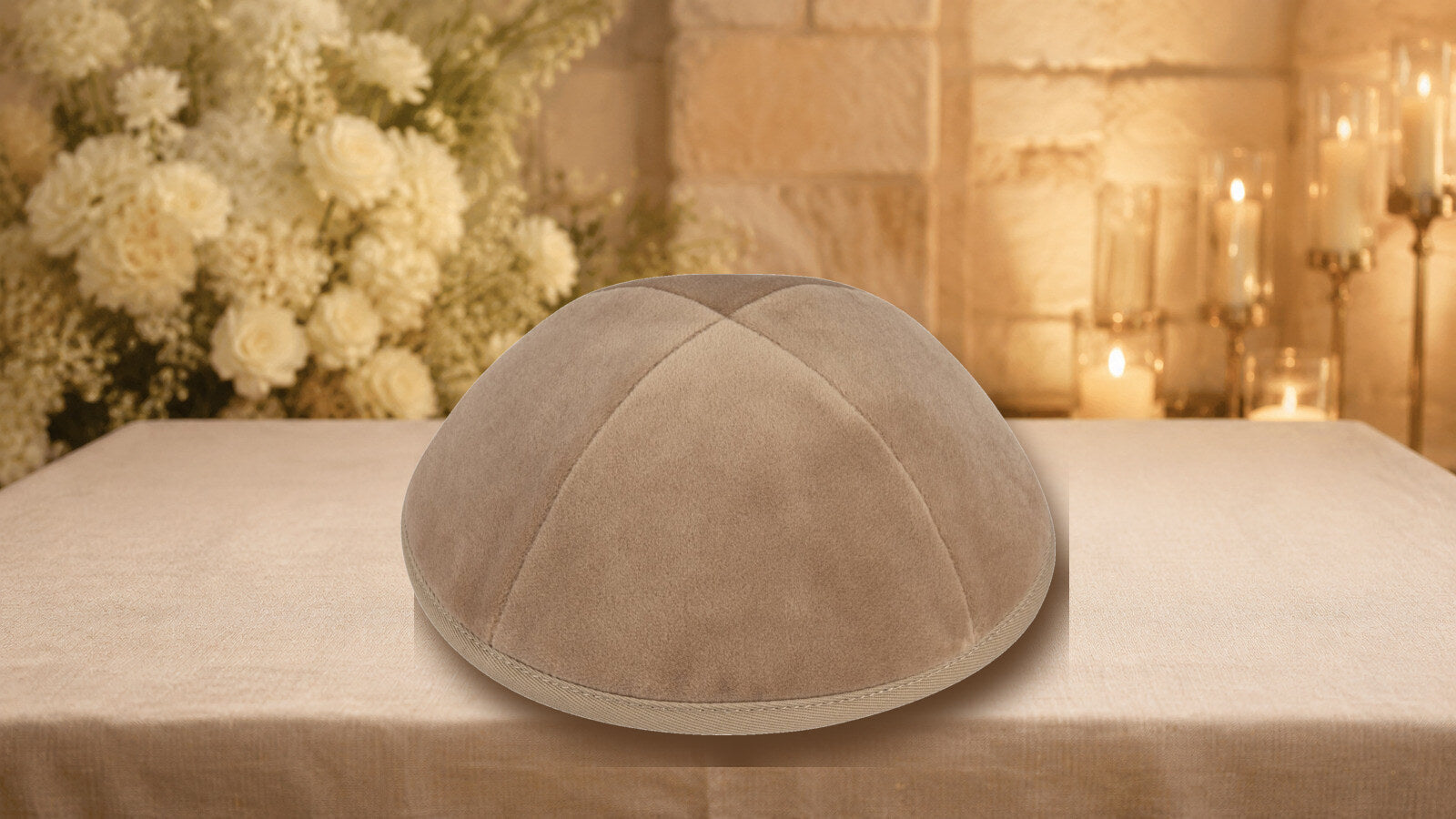
Velvet gives a rich, traditional look and holds a structured dome well. Dark colors feel classic for a Bar Mitzvah or wedding and can be worn again after the simcha. Check the rim, stitching, panel construction, and available sizes on the specific listing.
Raw silk, satin, and formal fabrics
These materials can coordinate beautifully with a wedding palette and often feel more event-specific. Their sheen changes under ballroom lighting and flash photography, so a physical sample or current product photograph is especially useful.
Linen and cotton
Linen and cotton can feel lighter and more understated. They work well when the event style is natural, warm, or less formal. Examine the weave and color in real lighting; beige, ivory, stone, and gray can shift noticeably between a screen and the venue.
Suede, leather, or knit
These can make a substantial keepsake and may be chosen when re-wear matters more than a traditional event look. Fit and shape vary, so review our yarmulke size, fit, material, and style guide before finalizing a less universal silhouette.
Choose the color in real conditions
A color that looks perfect on a phone may appear warmer, cooler, lighter, or shinier under venue lighting. Compare the kippah with the actual invitation paper, table linen, flowers, or clothing swatch if coordination matters.
- View the sample in daylight and warm indoor light.
- Take one phone photo with and without flash.
- Check contrast between the fabric and any stitching or imprint.
- Ask whether the chosen color is wearable after the event.
You do not need an exact match to every decorative element. A complementary neutral often looks more polished than a color that is close but noticeably off.
What should the personalization say?
Keep the wording readable and meaningful. Common information includes the names, the occasion, and the date, but the available lines, fonts, Hebrew, English, placement, foil colors, embroidery, and proofing process depend on the product.
Before submitting personalization:
- Write every name exactly as it should appear.
- For Hebrew, send the exact Hebrew letters rather than only an English transliteration.
- Decide whether the date should be Hebrew, English, or both.
- Confirm inside versus outside placement.
- Check capitalization, punctuation, line breaks, and spacing.
- Have a second person review the final proof against the original text.
Never approve a proof from memory. Compare it letter by letter with the wording the family approved.
Why a sample matters
A sample answers questions that a screen cannot: true color, texture, shape, fit, stitching quality, lining, clip compatibility, and how the material photographs. If a sample is offered and timing allows, inspect it before committing to a large personalized order.
Test the sample on several people rather than only one wearer. A bulk simcha kippah does not need to fit everyone identically, but it should sit reasonably well for the broad group you expect.
Check timing without guessing
Do not work backward from a generic internet turnaround. Stock status, quantity, personalization method, proof approval, production, holidays, and shipping can all change the schedule. Use the current product information and confirm the required arrival date before placing a personalized order.
Build in time to review a sample or proof, correct spelling, and inspect the shipment after it arrives. A rush option is helpful only when the seller confirms it for the exact item and quantity.
Final approval checklist
- Final event date and required arrival date confirmed
- Likely wearers counted without duplicate guest lists
- Additional ceremony or shul attendees included
- Reserve and family keepsakes added intentionally
- Package increments or minimum verified on the live listing
- Material and color checked in realistic lighting
- Sample reviewed when available
- Hebrew and English wording checked letter by letter
- Placement, font, foil, thread, or embroidery confirmed
- Final proof approved by two people
- Distribution plan assigned to one responsible person
Frequently asked questions
Do I need one kippah for every wedding guest?
Not automatically. Count the attendees likely to take or need one, add people present for the ceremony who may not be on the meal list, and add a reasonable reserve. Your event format and guest list matter more than a universal rule.
How many extra kippot should I order?
There is no single correct percentage. A small, invitation-only meal may need a modest reserve, while a large event with uncertain attendance or several entrances may need more. Add extras for a stated reason: last-minute guests, misplaced pieces, multiple displays, or keepsakes.
Should wedding or Bar Mitzvah kippot be personalized?
Personalization makes them memorable, but it is optional and product-specific. If you personalize, confirm the exact wording, placement, method, minimum, proofing process, and timing before ordering.
What is the best material for event kippot?
The best material depends on the desired look, budget, fit, venue lighting, and whether you want guests to wear the kippah again. Velvet is classic and structured; formal fabrics coordinate easily; linen and cotton feel lighter; suede, leather, and knit can make substantial keepsakes.
Order from a plan, not a guess
The best simcha kippah order is not simply the biggest one. It is the order that covers the real guest list, arrives with time to inspect it, looks right in the room, and preserves the exact family wording without mistakes.
Start with the Bulk & Event Kippot collection, then compare current wedding and Bar Mitzvah styles before finalizing your count.