





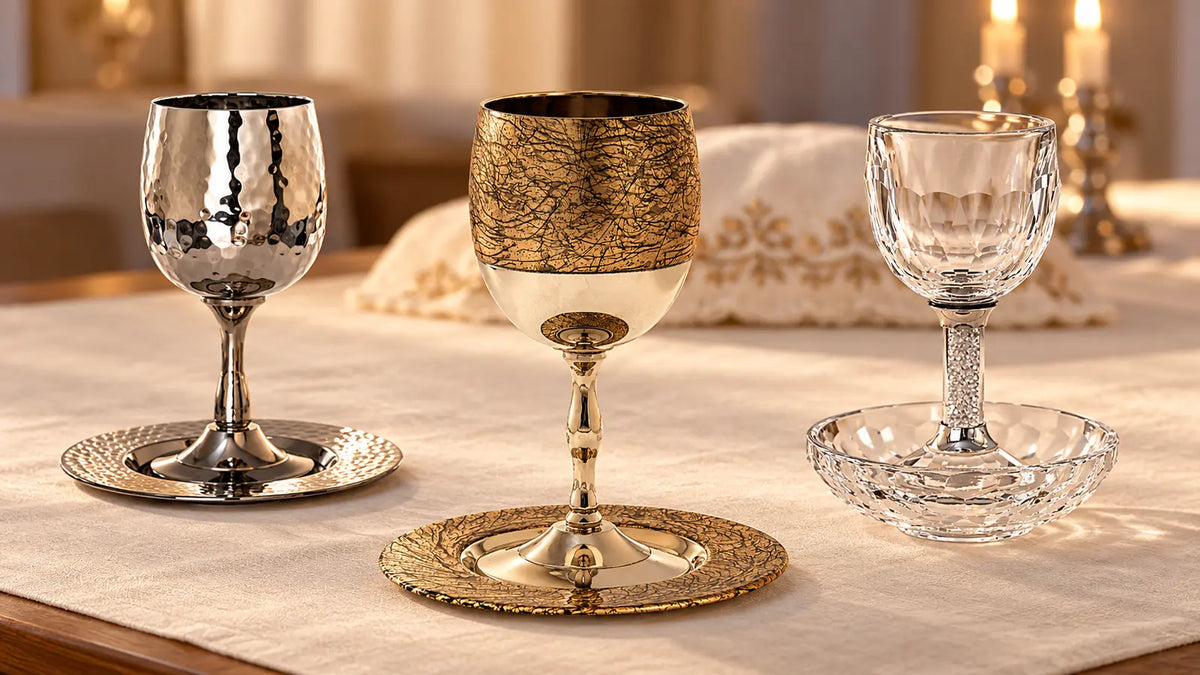
How to Choose a Kiddush Cup: Size, Material & Sets
You are standing in front of a shelf of Kiddush cups. One is tall and traditional, one is low and hammered, one is crystal, and one comes with a matching tray. The easiest mistake is to choose by appearance alone. A cup can look substantial without stating its liquid capacity, and a beautiful finish can still be inconvenient for the person who will use it every week.
A better order is: confirm the halachic requirement for your household, check the exact product specifications, decide how the cup should feel in the hand, and only then choose the design. This guide will help with the shopping decisions. It is not personalized halachic guidance; questions about the required shiur, materials, wine or grape juice, and family minhag belong with your Rav.
Start with capacity, not height
A tall stem does not tell you how much the bowl holds. Chabad’s overview of what Kiddush is notes that a suitable cup must hold the required amount, while an OU Torah discussion of Kiddush-cup requirements explains that commonly followed measurements are not all identical. That is why this guide does not give one universal ounce number.
Before buying, look for a stated capacity in the exact listing. If only the height and diameter are shown, ask for the capacity rather than estimating from the photograph. Then confirm the applicable shiur with your Rav. This is especially important for a small child’s cup, a travel cup, or an unusually shallow design.
The 30-second Kiddush-cup decision
- Confirm the required capacity. Do not use height as a substitute.
- Choose the weekly-use priority. Is the cup mainly for a steady grip, an heirloom-style gift, easy care, or a more delicate table presentation?
- Decide whether a tray matters. A fitted tray gives the cup a defined landing place and catches drips, but it also takes more room in a cabinet.
- Check what is actually included. “Cup,” “cup with tray,” and a boxed Shabbos set are different purchases.
- Read the material and care line. Silver plated, stainless steel, crystal, enamel, resin, and sterling silver are not interchangeable descriptions.
When you are ready to compare current choices, browse the active Kiddush cups collection. Open the individual product page before ordering; the product title and photograph alone may not answer the capacity or care question.
Three real cup-and-tray styles, compared
The following current Judaica Square examples show how the practical differences appear in actual listings. They are not ranked, and availability can change.
| Current example | What the listing states | A useful reason to consider it | What to confirm |
|---|---|---|---|
| Hammered stainless-steel cup with tray | 5-inch cup; 5.5-inch tray; hammered stainless steel | A classic silver-tone look with a matching landing place | Liquid capacity and the care method for the exact finish |
| Faceted crystal cup with tray | 5¾-inch cup; 4¾-inch tray; crystal cup and tray | A transparent, light-catching presentation for a more delicate table setting | Capacity, storage space, and whether the household wants fragile crystal for weekly use |
| Gold-enamel cup with tray | 5.75-inch cup; 2.5-inch cup diameter; 5.2-inch tray; enamel finish | A warm gold accent without assuming that the piece is solid gold | Capacity and the manufacturer’s care directions for the enamel surface |

Choose the material for the person, not the display shelf
Stainless steel for a straightforward weekly-use option
Stainless steel avoids the ambiguity of a generic “silver-tone” description and appears across both small cup-only designs and larger stemmed sets. It may suit a household that wants a metal cup without choosing a plated or sterling-silver piece. Still check the exact finish, dimensions, included pieces, and care instructions; “stainless steel” does not tell you everything about the shape or surface.
Silver plated for a traditional look at a different material level
Silver plated means a silver layer over another material; it is not the same as solid sterling silver. Confirm that the listing explicitly says “silver plated,” then follow the maker’s care directions so you do not treat the finish like bare stainless steel. For a gift, use the correct material name in the card or description rather than calling every shiny cup “silver.”
Crystal or glass when transparency is part of the appeal
Crystal shows the color of the wine or grape juice and can feel especially dressy. The trade-off is practical: it needs protected storage and careful handling. A family with small children may still love crystal, but the buyer should make that choice knowingly rather than discovering the fragility after the first crowded Shabbos table.

Enamel and decorative finishes when color is intentional
An enamel band can bring color or warmth to a table without changing the cup into a different base material by implication. Read the listing literally. A product called “gold enamel” describes the finish and color; it does not mean solid gold. Decorative surfaces also deserve care instructions specific to that item.

Stemmed, stemless, heavy, or light?
Imagine the moment of Kiddush rather than the product sitting untouched in a display.
- A stem creates a clear place to hold the cup and keeps fingers away from much of the bowl. A very slim stem may feel less secure to someone with a weak grip.
- A stemless cup can feel compact and direct in the hand, but a wide polished body may show fingerprints or feel slippery depending on the finish.
- A broad foot or fitted tray can give the cup a stable place to rest. Check the actual base and tray dimensions instead of assuming every set uses a wide base.
- A heavier cup can feel substantial, but it may be tiring or awkward for a child or someone with limited hand strength.
If possible, hold the cup before buying. If ordering online, compare the listed dimensions with a cup you already own and like. A ruler beside the cabinet shelf is more useful than guessing from a close-up photograph.
Cup only, matching tray, or a complete gift set?
A cup-only purchase is sensible when the recipient already owns a tray or wants the smallest storage footprint. A cup-and-tray set feels finished and reduces the need to find a separate saucer. A larger Shabbos set can make a substantial wedding or housewarming gift, but only when the recipient needs all the pieces and has room for them.
For a ready-to-present option, the current stainless-steel Kiddush cup with filigree stem and tray is listed with a blue velvet box. That packaging detail belongs to this exact model; do not assume every cup in the collection arrives the same way.
Buying for a specific person
For your own weekly table
Prioritize grip, capacity, storage, and cleaning before matching the rest of the table. The cup you are comfortable using every week is more useful than a dramatic piece that stays in its box.
For a bar mitzvah boy
Confirm the family’s minhag and the required capacity before choosing a compact “first cup.” Check whether personalization is wanted and verify the Hebrew or English spelling before any engraving. A smaller-looking cup is not automatically the right size for Kiddush.
For a wedding or housewarming
Ask whether the couple already received a Kiddush cup, whether they prefer traditional silver tones or a contemporary finish, and whether they want a tray. A gift receipt or coordinated family list may be more helpful than surprising them with a second large set. For the wider gift decision, use the Jewish wedding gift guide.
For a guest cup or second table
A simple, sturdy material may matter more than elaborate decoration. Still verify capacity for the intended use. If the cup is only for distributing wine after Kiddush rather than making Kiddush over it, that is a different shopping need; describe it accurately when asking for help.
Care questions to ask before checkout
- What is the exact material and finish?
- Does the maker provide hand-washing or other care instructions?
- Can the decorative surface be exposed to the cleaner you normally use?
- Is the tray included?
- Is the cup boxed for storage or gifting?
- Are replacement pieces available if a crystal tray breaks?
Do not use a universal polishing or soaking method across plated metal, stainless steel, enamel, resin, glass, and crystal. Follow the instructions for the exact cup. When no care guidance is stated, ask before applying an abrasive cleaner or polish.
Your final 60-second checklist
- Required capacity confirmed for your household
- Capacity verified from the listing or seller, not inferred from height
- Material named precisely
- Stem and grip suit the user
- Cup-only versus tray set confirmed
- Cabinet space measured
- Care directions understood
- Personalization spelling approved before ordering
- Gift recipient’s taste and existing pieces considered
Once those points are clear, the visual choice becomes enjoyable instead of risky. Start with the current Kiddush cup collection, or place the cup within the rest of the table using the Shabbos essentials guide. The goal is not the most ornate cup on the shelf. It is a cup that is appropriate, comfortable, and genuinely welcome at the table every Shabbos.