




How to Choose a Challah Board: Size, Material & Sets
A challah board looks like a simple purchase until you start comparing shapes, materials, sizes, covers, knives, and sets. Then the questions arrive quickly: Will two challos actually fit? Can the surface be cut on? Is the knife included? Will the board feel crowded beside the becher, salt, and serving dishes?
The best challah board is not necessarily the largest or most ornate one. It is the piece that fits your table, your way of serving, and the amount of care you are willing to give it every week. This guide walks through those choices so you can browse challah boards, trays, and covers with a clear plan.
Start with how you will use the board
Before choosing a material, decide what job the board needs to do. Some families want one practical board for every Shabbos and Yom Tov. Others want a more formal piece for a dining room table, a compact board for an apartment, or a gift that looks complete as soon as it is opened.
Ask these questions first:
- Will the board hold two average challos, unusually large challos, rolls, or a mix?
- Will you cut directly on the board, or present on one surface and cut on another?
- Does the board need to share limited space with candlesticks, a kiddush cup, salt, and serving platters?
- Do you want a matching knife, challah cover, salt dish, crumb insert, or stand?
- Is easy weekly care more important than a highly decorative finish?
That short list prevents the most common disappointment: buying a beautiful piece that does not suit the way your family actually makes the seudah.
How big should a challah board be?
There is no single “standard” size that works for every household. Product dimensions are useful, but the right number depends on your challos and your table. A board that looks generous in a product photograph can feel very different once two full loaves are placed on it.
Measure the challos, not only the table
Place the two challos you normally use side by side in the arrangement you prefer. Measure the total length and width, then allow breathing room around them. If you often use larger homemade challos, measure those rather than a smaller weekday loaf. If the board will sit beneath a challah cover, check that the cover can drape neatly without catching under the feet or hardware.
Protect the working space around the board
Mark the proposed footprint on your table with a folded towel or a few sheets of paper. Set the rest of your usual Shabbos pieces around it. This simple test tells you more than an isolated dimension: it shows whether people can still pass dishes, pour wine, and reach the salt comfortably.
Compact boards suit smaller tables and lighter challos. Larger boards give generous presentation space and can make a strong centerpiece, but they also need storage space between uses. A piece such as the 14-inch Paldinox cherry wood board with knife illustrates a compact coordinated format, while the 20-by-15-inch Hadad Brothers wood-and-silver tray shows how much larger a formal statement piece can be. Always use the exact dimensions on the live product page rather than judging scale from a photo.
Wood, glass, or lucite: which material fits your table?
Material changes more than appearance. It affects weight, sound, knife contact, cleaning, storage, and how formal the board feels. The details also vary within each category, so treat the material as a starting point and then read the individual product description.
| Material | Why people choose it | What to check | Often suits |
|---|---|---|---|
| Wood | Warm, traditional look; often comfortable for cutting | Finish, hand-washing directions, drying, oiling, and whether decorative inlays are protected | Weekly use, natural tables, practical gifts |
| Glass | Crisp presentation; designs can appear beneath a clear surface | Whether it is intended for direct cutting, edge and foot construction, weight, and care directions | Modern tables, easy visual coordination, formal gifts |
| Lucite or acrylic | Light, contemporary appearance with many decorative styles | Scratch guidance, heat guidance, cleaning method, hardware, and the exact food-contact surface | Contemporary homes, coordinated sets, lighter-looking tables |
| Metal or mixed material | Formal presence and decorative detail | Whether the top is a cutting surface or display tray, polishing needs, weight, and removable inserts | Wedding gifts, Yom Tov tables, traditional dining rooms |
Wood challah boards
Wood challah boards bring warmth to the table and often pair naturally with a bread knife. Some are simple cutting boards; others combine wood with metal handles, resin, glass, leather-look panels, or decorative inlays.
Do not assume that every wooden board should be soaked, placed in a dishwasher, or treated with oil. Decorative components and finishes can change the care requirements. Look for the maker’s instructions, wipe crumbs promptly, and let the piece dry fully before storing it. If the product page does not make the intended cutting surface clear, ask before using a serrated knife on it.
Glass challah boards
Glass challah boards offer a clean surface and can display artwork beneath the top. They range from understated designs to highly decorated trays with feet or layered construction. Glass also tends to feel visually lighter than a heavy wood or metal piece, even when the actual board is substantial.
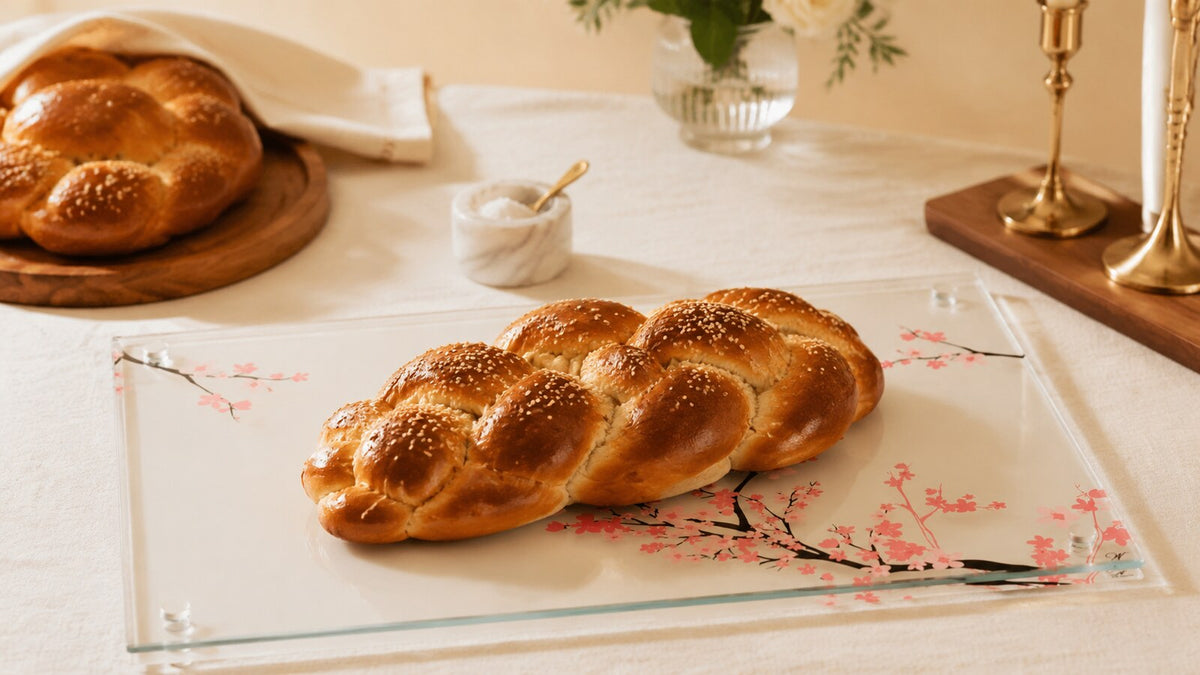
The important question is whether the specific surface is designed for direct cutting. A hard surface can be less forgiving to a knife, and raised hardware or decorative layers can affect how the board should be used. Check the listing for the construction, care directions, and included pieces. The Cherry Blossom challah board used in this article’s photograph, for example, is a real Judaica Square lucite-and-tempered-glass design; its live page provides the current construction and availability details.
Lucite and acrylic challah boards
Lucite challah boards work well in homes that prefer a contemporary, airy look. Clear layers can make the board appear to float above the tablecloth, and designers can build color, floral art, Hebrew motifs, or matching accessories into the set.
Lucite is a broad shopping label, not a universal care promise. One piece may have a glass top while another uses an acrylic working surface. Confirm the actual top layer, how it should be cleaned, whether it can scratch, and whether hot items may be placed on it. Never transfer care claims from one product to another simply because both are described as lucite.
Silver, metal, marble-look, and mixed-material trays
These pieces are often chosen for visual impact. They can be beautiful wedding or housewarming gifts and may coordinate with a formal becher, candlesticks, or flatware. Their tradeoffs are practical: some are heavy, some require polishing, and some are presentation trays rather than cutting boards.
Look closely at the food-contact surface. If the decorative top is not intended for a knife, plan to slice on a suitable removable insert or separate board and return the challah to the tray for serving. Check whether glass panels or inserts lift out for cleaning and whether the feet are stable on your tablecloth.
Should you buy a board, a tray, or a complete set?
Product titles use “board” and “tray” somewhat loosely, so the photograph and included-pieces list matter more than the label.
- A cutting board is meant to be a working surface. Confirm the maker’s use and care directions.
- A presentation tray may prioritize decorative materials and serving rather than knife contact.
- A board-and-knife set removes the need to match pieces separately, but verify that the knife is actually included.
- A board-and-cover set creates a coordinated look and makes a polished gift. Confirm the cover’s measurements as well as the board’s.
- A full challah set may add a knife, cover, salt dish, pouch, stand, or other accessory. Read the list; never rely on props shown in a photograph.
If you already own a favorite board, a new challah cover or one of the store’s challah knives may be the more useful upgrade. If you are starting from scratch, a coordinated set simplifies the decision.
Five details shoppers often miss
1. The knife may be photographed but not included
A styled image can show how a piece looks in use without defining what comes in the box. Check the title, description, and included-pieces section. If “with knife” is not stated, assume nothing.
2. Feet and raised edges change the feel
Feet can give a board presence and protect the table, but they also raise the cutting surface. Make sure the board feels stable and that the working height is comfortable. On a layered board, check that the hardware is positioned away from where the knife will travel.
3. A crumb insert is useful only if it is easy to empty
Slats and crumb trays can keep the table neater. Look at how the insert lifts out, whether crumbs can collect around decorative edges, and how each component should be cleaned.
4. The challah cover needs its own measurements
A beautiful cover can look undersized over two large challos or overwhelm a compact board. Measure the arrangement as a whole. When buying a set, confirm that the pictured cover is the one included and whether color choices are available. The separate challah-cover buying guide explains table covers, Hafrashas Challah bowl covers and clear protectors.
5. Storage matters
Think beyond Friday night. A heavy tray may need a sturdy shelf; a tall footed board may not fit in a shallow cabinet; a large lucite piece needs protection from scratches. If the board will be stored vertically, make sure that is appropriate for its construction and hardware.
How to choose a challah board as a gift
A challah board is a strong Jewish wedding, housewarming, anniversary, or hostess gift because it can be used every week. It is also a style-sensitive gift. Before choosing, notice whether the recipient’s home leans warm and wooden, crisp and modern, or traditional and silver-toned.
For a wedding, check the registry when one exists and consider whether the couple may already receive more than one challah set. A distinctive board can still be welcome, but a coordinated cover, knife, or store gift card may be more flexible when you do not know their table or minhagim. Browse the Shabbos table gift collection when you want to compare the board with other practical options.
For more context, see the Jewish wedding gift guide. Newer households can also use the broader Shabbos essentials checklist to decide what is most needed first.
A simple buying checklist
Before adding a challah board to your cart, confirm:
- the exact outside dimensions and usable surface area;
- that your usual two challos fit with room around them;
- whether the surface is intended for direct cutting;
- the materials in every layer, insert, handle, and foot;
- the maker’s cleaning, drying, scratch, and heat guidance;
- which accessories are included rather than merely pictured;
- the measurements of any included challah cover;
- the board’s weight, height, stability, and storage needs; and
- whether the style coordinates with the table where it will be used.
When those details line up, the purchase becomes much easier. Choose for the real table, not only the product photograph, and you are more likely to enjoy the board every week.
Frequently asked questions
What size challah board do I need for two challos?
Measure the two challos you normally serve in the arrangement you prefer, then add room around them for comfortable handling and cutting. Also test that footprint beside the other items on your Shabbos table. There is no one correct size for every family.
Is wood or glass better for a challah board?
Wood often offers a warm look and a practical working surface. Glass offers a crisp presentation and protects artwork placed beneath it. The better choice depends on whether you cut directly on the board, how much weight you prefer, and the care directions for the exact item.
Can you cut challah directly on a glass or lucite board?
Only when the product’s construction and maker guidance indicate that the top is intended for cutting. “Glass” or “lucite” can describe different layered designs. If the listing is unclear, ask before using a serrated knife on the decorative surface.
Does a challah board usually include a knife and cover?
Not necessarily. Some listings are board only, while others are coordinated sets. Read the included-pieces description carefully and do not assume that every item styled in the photograph is part of the purchase.
Is a challah board a good wedding gift?
Yes, especially when it matches the couple’s taste and table size. Check the registry where possible, confirm what is included, and consider a coordinated set if you want the gift to feel complete. The related kiddush cup guide can help if you are comparing classic Shabbos-table gifts.