



How to Choose a Challah Cover: Size, Material & Protection
A challah cover is one of those Shabbos-table pieces that looks simple until you start shopping. Then the questions arrive: Will it actually cover two challos? Is an embroidered fabric easier to live with than a leather-look finish? Does “Hafrashas Challah cover” mean the same thing? And is the clear plastic item a cover by itself—or protection for another cover?
The easiest way to choose well is to begin with the job the item needs to do. This guide separates the three products that are often grouped together, then walks through size, material, care and gifting without turning a practical purchase into a guessing game.
Quick answer: For the Shabbos table, choose a decorative cover that extends comfortably beyond the challos you normally serve. For challah baking, choose a bowl-sized Hafrashas Challah cover. For a decorative cover you want to shield from spills, choose a properly sized clear protector to go over it. These are related items, but they are not interchangeable.
First, identify which kind of challah cover you need
A regular Shabbos-table challah cover
This is the decorative cover placed over the challos on the table. Its shape is usually rectangular because it needs to sit neatly over one or two challos, often on a board or tray. The design becomes part of the table setting, so both the dimensions and the visual style matter.
A current example is the Floral Bird Challah Cover. The catalog lists it at 17.5 by 22 inches, with a faux-leather surface, cotton backing and wipe-down care. Those details make it useful as a measuring reference even if you prefer a different design: compare that footprint with the challos and board you use at home.
A Hafrashas Challah bowl cover
A Hafrashas Challah cover is meant for the bowl during dough preparation and rising. It is generally shaped and sized for that kitchen task, not for laying over two challos on a serving board. The wording on the product page should make that use clear.

For example, the Leaf Hafrashas Challah Cover is listed as a 19.5-inch square linen cover with embroidery and machine-washable care. Its size and purpose are different from the rectangular table cover above.
A clear protective cover
A protector is a practical outer layer placed over a decorative challah cover. It can help when the table is busy, young children are nearby or the cover has embroidery you would rather not expose directly to soup, wine or sticky fingers. A protector does not replace the decorative cover unless that very plain presentation is what you want.
Protection only works when the sizes match. The clear challah-cover protector is sold in multiple sizes; select the size only after checking the dimensions of the cover underneath.
Measure the way you actually set the table
Do not measure an empty board and stop there. Put the number and shape of challos you normally serve onto the board or tray, then measure the full arrangement. Round challos, tall braided challos and a crowded board can all need more drape than a flat measurement suggests.
- Place your usual challos on the board or tray.
- Measure the widest and longest points of the bread arrangement.
- Decide how much of the board you want visible around the edges.
- Compare those numbers with the exact product dimensions—not with “standard” in the title.
- If adding a protector, confirm that it fits the decorative cover rather than only the challos.
If this is a gift and you cannot measure, a product with two explicitly listed size choices is easier to evaluate than one described only as small or large. The Classic Leather Challah Cover, for instance, currently lists a small 15-by-18-inch option and a large 17-by-22-inch option. That does not make either size universal; it gives you concrete numbers to compare.
Choose material for the household, not only the photograph
The prettiest cover on a product grid is not automatically the easiest cover for a particular home. Think about texture, cleaning instructions, storage and how formal the table usually feels.
Embroidered fabric: soft, detailed and traditional
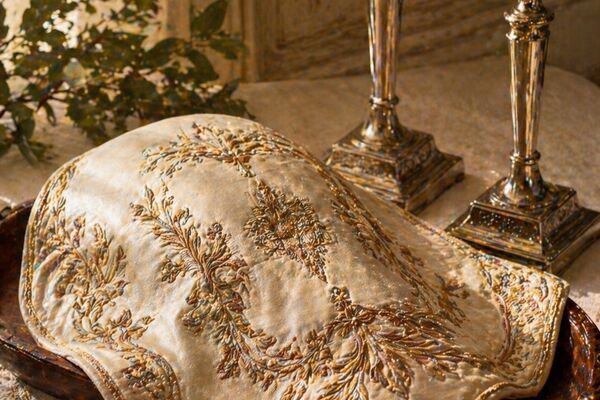
Embroidery gives a cover depth and visual detail. It can feel especially at home on a more formal table and makes a substantial wedding or housewarming gift. The tradeoff is that stitching and decorative fabric deserve more careful handling. Check the maker’s instructions before washing, ironing or treating a stain; do not assume that every embroidered cover is machine washable.

The Emanuel pomegranate embroidered challah cover is a useful example of that decorative direction. The linked page identifies the exact design; it does not supply a universal care rule for every embroidered cover.
Leather-look surfaces: structured and practical
A leather or faux-leather look gives the table a cleaner, more structured line. Some models are designed to wipe down, which can be convenient for weekly use. But “leather look” is not itself a care instruction. Check whether the page says faux leather, genuine leather or another material, and follow the instructions for that exact item.
The Floral Bird example above is specifically described as faux leather with wipe-down care. That is a verified detail for that product—not a promise about every cover in the department.
Fabric bowl covers: designed around baking
For a Hafrashas Challah bowl cover, softness, washability and the bowl footprint may matter more than how the item pairs with a challah board. The Leaf cover is listed as linen and machine washable, while other bowl covers may use different materials. Again, the exact listing should decide the care routine.
A side-by-side decision guide
| What you need | Look for | Check before buying |
|---|---|---|
| Covering challos on the Shabbos table | Rectangular decorative table cover | Dimensions over your usual challos and board; material; exact care |
| Covering dough during challah preparation | Hafrashas Challah bowl cover | Bowl footprint, shape, fabric and washability |
| Shielding a decorative cover | Clear protective sleeve or outer cover | Protector dimensions compared with the cover underneath |
| Giving a wedding or housewarming gift | A size and style that suit the recipients’ table | Whether they already own one, their color direction and any personalization lead time |
How to choose a challah cover as a gift
A challah cover can be a thoughtful gift because it is useful without requiring the giver to choose a sefer edition or clothing size. Still, it is not completely preference-free. A modern white-and-gold table, a colorful family table and a traditional silver setting may call for very different designs.
If possible, learn three things before ordering:
- The table style: restrained, colorful, traditional or contemporary.
- The likely footprint: a compact board for two smaller challos or a wider presentation.
- The household routine: whether easy wipe-down care or a protective outer cover would be especially helpful.
For a couple establishing a home, a cover can pair naturally with a board—but the two purchases should be sized together. The challah-board buying guide explains board materials, footprints and sets. For a broader present, the Jewish wedding gift guide helps compare table Judaica with other useful choices.
A practical care routine
Good care begins before there is a stain. Keep the product instructions with the cover, store it flat or loosely rolled if the construction allows, and avoid pressing textured embroidery under a heavy stack. If the cover is used weekly, a correctly sized protector can reduce how often the decorative piece needs attention.
When something spills, use only the care method stated for that exact material. A wipe-down faux-leather cover, a washable linen bowl cover and an embroidered textile should not be treated as though they are the same surface. If the maker’s instructions are missing or unclear, pause before using heat, bleach, stain remover or a washing machine.
Before you check out
- I know whether I need a table cover, bowl cover or protector.
- I checked dimensions against the challos, board, bowl or decorative cover it must fit.
- I read the exact material and care details.
- I chose a design that belongs on this household’s table—not only one that photographs well.
- If it is a gift, I checked for duplication and any personalization or timing questions.
You can now browse the live challah-cover and protector collection with the three use cases in mind. If you are setting up the full table rather than choosing one item, the Shabbos Essentials guide provides a broader planning checklist.
Frequently asked questions
What size challah cover should I buy?
Measure your usual challos arranged on the board or tray, then choose a cover with enough extra length and width to drape comfortably. Use the product’s stated dimensions rather than assuming that “standard,” “small” or “large” means the same thing across brands.
Is a Hafrashas Challah cover the same as a Shabbos-table cover?
No. A Hafrashas Challah cover is designed for the dough bowl during challah preparation and rising. A regular challah cover is designed to cover the challos on the table. Read the title, dimensions and product type carefully because stores may group both in one department.
Can I put a clear protector over an embroidered challah cover?
Yes, if the protector is designed for that use and its dimensions fit the decorative cover underneath. Measure the decorative cover itself before choosing the protector size.
Is a challah cover a good wedding or housewarming gift?
It can be a useful, meaningful table gift. The best choice fits the recipients’ table size and style and does not duplicate a cover they already own. If personalization is involved, confirm the exact options and timing on the product page before ordering.