




Sukkos Books for Kids: A Parent’s Age-by-Age Guide
A Sukkos book works best when it matches what a child can do right now. A toddler may want to point to a lulav and say the word. A preschooler may enjoy lifting flaps or answering a simple riddle. An early reader may be ready for a full story, while an older child may want something with more plot, detail, or independent reading value.
That is why “What is the best Sukkos book for kids?” is usually the wrong first question. The better question is: What kind of Sukkos experience will help this child connect?
This guide will help you choose by age, attention span, reading level, and purpose. If you want to see the current shelf while you read, start with Judaica Square’s live Sukkos books collection, which includes children’s stories alongside learning and halacha seforim for adults.
The quick answer: choose by interaction, not only by age
Age labels are useful, but they do not tell the whole story. Two five-year-olds may need completely different books: one may sit through a detailed read-aloud, while the other wants bold pictures and a page turn every few seconds. Use the age ranges below as a starting point, then adjust for the child you know.
| Reader stage | What usually works | What to check |
|---|---|---|
| Babies and toddlers | Board books, clear pictures, familiar Sukkos objects, very short text | Sturdy pages, simple vocabulary, uncluttered spreads |
| Preschoolers | Lift-the-flap, rhymes, questions, repetition, short stories | Enough interaction to hold attention without making the page confusing |
| Early elementary | A complete plot, relatable family scenes, mitzvah concepts explained through story | Read-aloud length, emotional tone, and whether the child can follow the sequence |
| Independent readers | Longer stories, chapter books, humor, adventure, or deeper Yom Tov themes | Print size, chapter length, vocabulary, and genuine interest |
| Mixed-age family | One short picture book plus one longer story or activity | Something the youngest can see and the oldest can help lead |
Sukkos books for babies and toddlers
For the youngest children, the goal is recognition. They do not need a full explanation of every part of Yom Tov. They benefit from seeing a sukkah, lulav, esrog, decorations, guests, and familiar foods, then hearing the same words again and again.
Look for a board book with:
- one clear idea per page;
- large, colorful images;
- very short sentences or labels;
- sturdy pages that can handle repeated reading;
- objects the child will soon see at home, in shul, or in the sukkah.
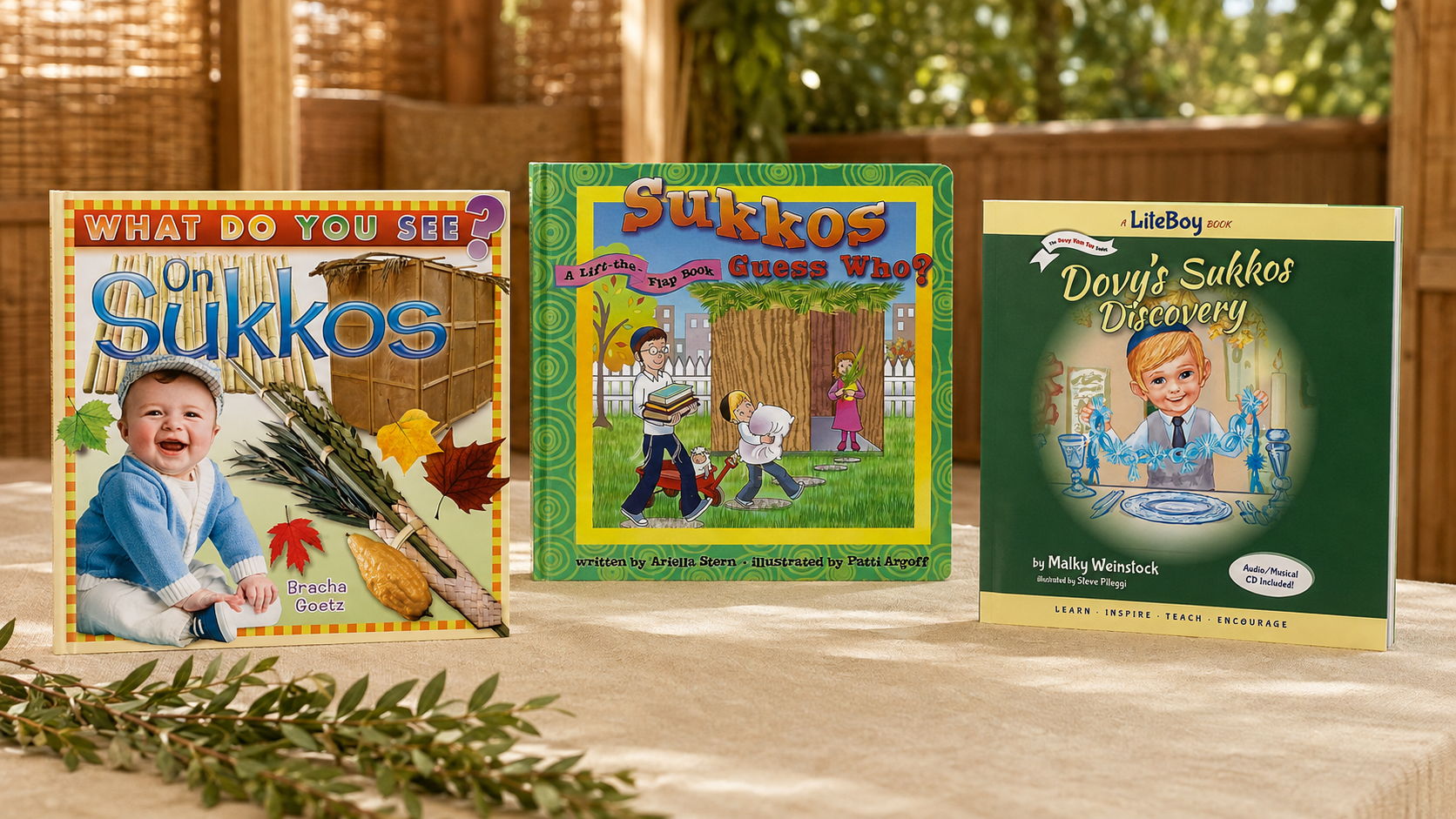
A word-and-picture title such as What Do You See on Sukkos? is designed around that first-vocabulary stage. The useful test is simple: can you point, name, and let the child answer—even if the “answer” is only a smile or a sound?
Sukkos books for preschoolers
Preschoolers often learn best when the book asks them to participate. They may enjoy guessing what comes next, opening a flap, repeating a rhyme, finding an object in the picture, or telling you what they remember from last year.
An interactive title such as Sukkos Guess Who? turns reading into a small game. That can be especially helpful before Yom Tov, when the vocabulary is still becoming familiar.
What makes an interactive book good?
The interaction should support the Sukkos idea, not distract from it. A strong interactive book gives the child a quick success: guess, lift, point, repeat. If every page needs a long explanation from the adult, it may be better saved for a later stage.
Preschool is also a good time for simple “why” stories. Children begin asking why the family eats outside, why the roof looks different, why adults carry the arba minim, and why the house is suddenly full of decorations. A short story can answer one of those questions in a way that feels natural rather than like a lesson.
Sukkos books for early elementary readers
Once a child can follow a beginning, middle, and end, a full story becomes much more valuable. Look for a main character with a question or small problem, a clear emotional arc, and a resolution the child can retell.
Dovy’s Sukkos Discovery, for example, begins with a child’s practical question about why the family eats in the sukkah. That kind of setup works because it starts where many children actually are: curious about what the family is doing and why.
At this stage, do not judge only by whether the child can decode every word. A book can still be an excellent family read-aloud even if independent reading is a year away. Check the number of lines on each page, the size of the print, and whether the pictures still help carry the story.
Questions that extend the story naturally
- What did the character notice first?
- What would you have asked?
- Which part reminds you of our sukkah?
- What should we look for when we go outside?
- Can you tell this story to someone else at the Yom Tov table?
One or two questions are enough. The goal is a warm conversation, not a quiz.
Sukkos books for older children and independent readers
Older children usually need more than a holiday label on the cover. They may prefer humor, mystery, family drama, historical fiction, a biography connected to the season, or a sefer that gives them something worthwhile to share at the table.
Before buying, open to a middle page—not only the first page. The beginning may be unusually easy because it introduces the characters. A middle page gives you a better sense of the real vocabulary, paragraph length, and pace.
For a reluctant reader, choose a quick win: short chapters, strong dialogue, illustrations, or a topic the child already enjoys. For a child who reads constantly, look for a richer story rather than simply buying something marked for an older age.
The broader Jewish children’s books collection is useful when the child wants a substantial story and the Sukkos-specific shelf feels too young. You can also use the ArtScroll children’s books guide to compare stories, middos books, Yom Tov reading, and family read-aloud choices.
Decide what you want the book to do
It is easier to choose once you know the job. Most Sukkos books serve one of five purposes.
1. Introduce holiday words
Choose a board book or simple picture book. This is best for a child seeing the objects for the first time.
2. Build excitement before Yom Tov
Choose a colorful story about preparing, decorating, welcoming guests, or experiencing the sukkah. Read it during the week before Sukkos, then bring it out again when the real objects are in place.
3. Answer one child-sized question
Choose a story with a clear question at its center. Trying to explain the entire Yom Tov in one book often gives younger children too much information at once.
4. Separate preparation-day crafts from Yom Tov reading
For the days before Yom Tov, choose an age-appropriate craft from our coloring and activity books or Sukkos children’s collection. Complete coloring, cutting, gluing and sticker projects before Yom Tov. For a quiet Yom Tov afternoon, set out suitable storybooks and follow your family’s practice for other activities.
5. Give a useful Yom Tov gift
Choose something the child can enjoy immediately. A sturdy picture book is often safer for a young child you do not know well; an older reader is more likely to need a recommendation from a parent who knows current interests and reading level.
Build a small Sukkos basket without overbuying
You do not need a large seasonal library. A three-part basket works for many families:
- One familiar favorite the child already knows and will happily reread.
- One new story that introduces a fresh question, character, or idea.
- One preparation-day project, such as an age-appropriate activity book or stickers, to use before Yom Tov.
For siblings, add one item that the older child can read to the younger child. That gives the older child a real role and keeps the basket from becoming a pile of separate purchases.
What to check before buying a Sukkos children’s book
Format and durability
Board books suit little hands. Hardcover picture books work well for family reading. Softcovers are lighter and may be easier to pack, but they need more care around food, weather, and younger siblings.
Language and reading level
Check whether the book is English, Hebrew, Yiddish, bilingual, or mainly visual. “For children” does not automatically mean “for beginning readers.” Page count, print size, and the amount of text per spread are more useful than the cover alone.
Tone
Some children want cheerful preparation and humor. Others enjoy a thoughtful explanation. A child who is anxious about unfamiliar routines may benefit from a predictable story that shows what the day will look like.
Read-aloud length
A beautiful book can still be the wrong choice if it takes twenty minutes and your child is ready for five. Longer is not automatically better. The right length is the one that lets you finish while the child still wants another page.
Physical setting
If you plan to read in the sukkah, protect books from damp tables, wind, spills, and overnight moisture. Bring them back indoors after use unless you have a dry, protected storage setup.
Common mistakes parents can skip
- Buying only by the age printed online. Match the actual child’s attention and reading stage.
- Choosing five books that all do the same job. Mix vocabulary, story, and activity.
- Saving every new book for the first night. Read one beforehand so the child enters Yom Tov with familiar words and pictures.
- Turning the read-aloud into a test. Let the story be enjoyable. Conversation will follow more naturally.
- Leaving books outside. Even a covered sukkah can become damp or windy.
- Buying an advanced book because it seems more educational. A simpler book a child requests repeatedly usually teaches more than a sophisticated book that stays closed.
A simple reading rhythm for the week before Sukkos
Bring out the Sukkos basket before the holiday rather than waiting until the table is crowded and everyone is tired. Read the shortest book first. The next day, point out one real object from the story. Later in the week, add the longer story or activity.
Once the sukkah is ready, let the child carry one book outside and find something from its pages: a decoration, a picture of a lulav, a place for guests, or the schach overhead. The connection between book and real life is what makes seasonal reading memorable.
If you are organizing the rest of the household at the same time, Judaica Square’s Sukkos 5787 preparation checklist covers the sukkah, arba minim arrangements, machzorim, table needs, children, guests, and storage.
Planning past the sukkah? The Simchas Torah with kids guide covers hakafos, flags, age-appropriate participation, clothing, supervision, and a calmer shul plan.
Frequently asked questions
How many Sukkos books does a child need?
There is no required number. One well-matched book read several times can be more useful than a large stack. For many families, one familiar title, one new story, and one activity is plenty.
Should I choose “Sukkot,” “Sukkos,” or “Succos” when searching?
They are common English spellings for the same Yom Tov. Retailers and publishers may use different spellings, so try more than one if a search result looks too narrow.
Are Sukkos books a good gift for children?
Yes—especially before Yom Tov, when the child can use the gift right away. For a child you do not know well, a picture-heavy family read-aloud is usually easier to match than an advanced independent-reading book.
Can a children’s book teach the halachos of Sukkos?
A children’s book can introduce concepts and vocabulary, but it should not replace guidance from a parent, rebbi, teacher, or rav. For practical halachic questions about the sukkah, arba minim, or Yom Tov observance, follow your family’s practice and ask the appropriate halachic authority.
Choose the book the child will actually open
The best Sukkos book is not necessarily the newest, longest, or most educational-looking title. It is the one that fits the child well enough to be opened, enjoyed, and requested again.
Start with the child’s stage, decide what you want the book to do, and keep the seasonal shelf small enough to feel special. Then browse the live Sukkos books collection or the full Sukkos 5787 department for books, machzorim, decorations, and arba minim accessories.