



What to Bring to a Sukkos Meal: Host Gift Ideas That Make Sense
You have been invited to a Sukkos meal. The host has planned a menu, arranged the sukkah, found enough chairs, and probably checked the weather more than once. You would like to arrive with something thoughtful—but not another item that needs to be chilled, plated, or found a place on an already full table.
The easiest rule is simple: choose a gift that reduces work rather than creating it. A compact table accessory, a useful Shabbos item, or a flexible gift card can feel generous without asking the host to make one more decision during Yom Tov.
This guide is about choosing well, not about a required custom. A host gift is a warm gesture, not an obligation. Family practice, the relationship, and the kind of invitation all matter.
The 30-second Sukkos host-gift decision
Before looking at products, answer three questions:
- How well do you know the host's taste? If you know their table and colors, a serving or textile piece can be personal. If you do not, choose something neutral and compact.
- When will you give it? A gift ordered or delivered before Yom Tov gives the host time to put it away. If you are bringing it to the meal, favor something easy to carry and already gift-ready.
- Could it create work? Food may need kashrus, allergy, refrigeration, or menu coordination. A non-food gift often avoids those questions.
If you are still unsure, start with Judaica Square's curated hostess-gift collection. It is a focused selection rather than a broad catch-all gift aisle.
What makes a host gift especially useful for Sukkos?
Sukkos meals have their own practical realities. Table space may be tighter than it is indoors. Guests may be walking between a house and a sukkah. Wind, temperature, and stairs can turn a beautiful but fragile present into an awkward package. The most successful gifts tend to share four qualities:
- They travel easily. A compact, boxed item is easier than a tall open arrangement or a heavy platter.
- They work beyond one week. A gift that can return to the Shabbos table all year has lasting value.
- They do not demand immediate use. The host should be able to thank you and set it aside without rearranging the table.
- They match the household. Neutral materials and understated colors are safer when you do not know the decor well.
Sukkos also gives hospitality unusual prominence. Chabad's explanation of the ushpizin describes the seven honored spiritual guests associated with the days of the festival. A host gift does not need to be symbolic, but it can recognize the real effort behind welcoming people into the sukkah.
Six host-gift directions that solve different needs
1. A compact serving piece for the host who entertains often
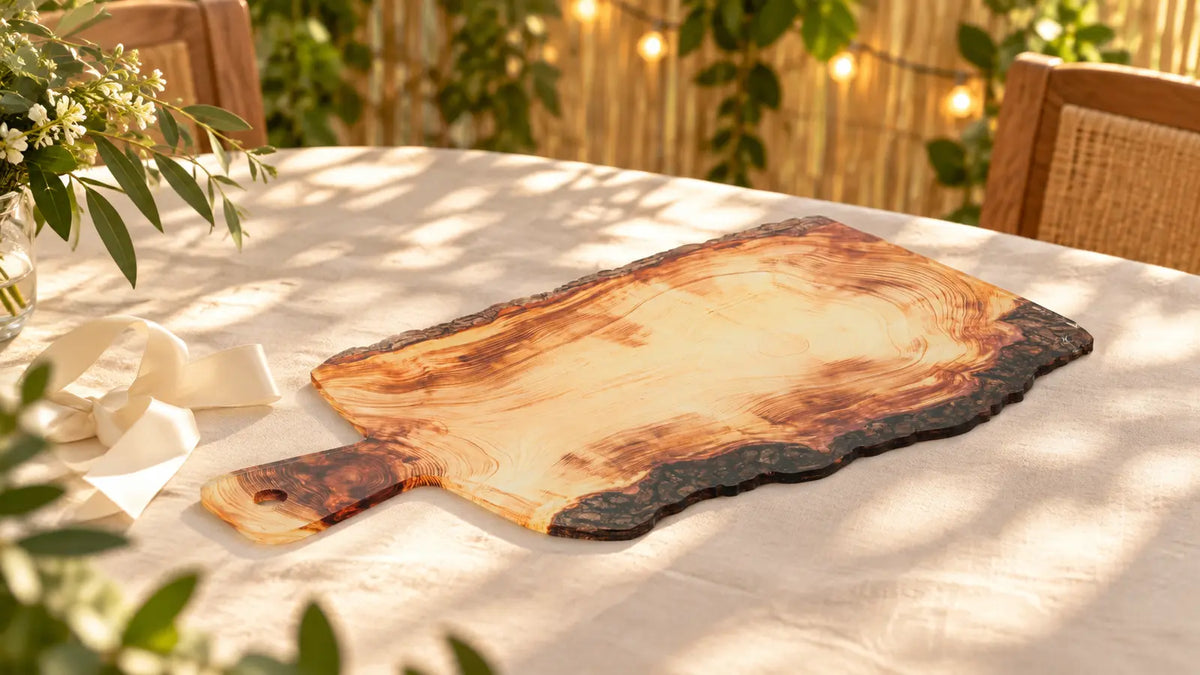
A small serving board or tray is useful without taking over the table. Look for a size that can handle fruit, candy, crackers, or a small dessert arrangement rather than a large board that needs its own cabinet.
One current example is the Waterdale wood-print lucite charcuterie board. Its 6-by-15-inch format is narrow enough for a crowded table, while the rubber grips help it sit securely. The wood appearance is a print on lucite—not solid natural wood—so choose it for its warm look and practical format rather than assuming a different material.
2. A salt piece for a host who likes a finished table
A salt cellar is small, useful, and easy to set aside until the next meal. It is also less taste-specific than wall art. The resin salt cellar includes a small spoon and is currently offered in available neutral finishes. Because the resin is hand-poured, the pattern can vary from piece to piece; that variation is part of the material rather than a flaw.
If you know the host prefers paired table accessories, salt shakers are another direction. If you do not know, one compact cellar is often the simpler choice.
3. A finger towel for a useful, lower-pressure thank-you
For a neighbor, casual invitation, or a meal where you do not want the gift to feel oversized, a neatly packaged finger towel can hit the right note. The scalloped cotton finger towel measures 12 by 20 inches and is embroidered with על נטילת ידים. Several colors are listed, but availability varies by color; check the live selector before ordering and choose a neutral available shade when you are unsure of the room.
4. A challah cover when you know the host's style
A challah cover can feel more substantial, but it is also more visible and taste-dependent. Choose one when you know the family prefers modern, traditional, embroidered, or easy-care materials.
The classic embossed challah cover is a minimalist faux-leather option with שבת ויום טוב embossed in the corner. It measures 17 by 22 inches and is designed to wipe clean. For a fuller comparison of textiles, sizing, and protection, see the challah-cover buying guide.
5. A small Judaica item when you know the household
A Kiddush card, Hadlokas Neiros booklet, or match holder can be meaningful, but these are more personal than a serving piece. Language, layout, household practice, and the place where the item will be used all matter. They are strongest when you have seen the home or know what the recipient would genuinely use.
Do not treat a religious text or ritual object as generic decor. Read the product description carefully, confirm what text is included, and make sure the item fits the recipient rather than choosing only by color.
6. A gift card when taste or timing is uncertain
A gift card is not an impersonal fallback when it solves a real uncertainty. It may be the most considerate choice for a host who has a very specific table, is moving, or already owns a large Judaica collection.
Judaica Square offers both a physical card for use in its Lakewood stores and an email gift card usable online or in store. Send an email gift before or after Yom Tov, not with an expectation that the recipient shop during Yom Tov.
Should you bring food?
Sometimes food is exactly right—especially when the host asks for it. But an uncoordinated dessert, wine, or prepared dish can create questions about kashrus, allergies, refrigeration, serving utensils, and the planned menu.
If you want to bring food, ask first. A short message such as “Would a dessert be helpful, or would you prefer that I bring nothing?” gives the host an easy choice. If the answer is “nothing,” believe it. A handwritten note or small non-food gift can still express thanks without changing the meal.
Choose by the kind of invitation
A first-time invitation
Stay neutral and compact: a salt piece, finger towel, modest serving accessory, or gift card. Avoid personalized text unless you have confirmed spelling and timing.
Close family or friends
You have more room to choose by personality. A challah cover, home blessing, or coordinated table item may work because you know what they own and what they like.
A group gift
One useful piece is usually better than several unrelated small gifts. Decide who will order it, who will write the card, and whether personalization is actually needed. Group purchasing should reduce duplication, not produce a larger object the host has nowhere to keep.
A last-minute invitation
Do not let speed push you into a random gift. Choose a ready-to-give item or send a digital gift afterward. If pickup or local delivery matters, confirm the current option and timing at checkout rather than assuming it will be available.
A practical packing checklist
- Remove or cover the price before wrapping.
- Keep the product box if it protects a fragile or acrylic piece.
- Use a bag with handles if you will be walking to the meal.
- Skip bulky bows that may crush in transit.
- Add a short card so the host knows who the gift is from.
- Give it without expecting the host to open or display it immediately.
The best gift is the one that respects the host's evening
A thoughtful Sukkos gift does not need to be large, seasonal, or expensive. It needs to fit the relationship and arrive without creating extra work. When in doubt, choose something compact, useful after Yom Tov, and easy for the host to receive graciously.
For wider holiday preparation—from books and decorations to table needs—use the Sukkos preparation checklist or browse the active Sukkos collection.